How to Build Brand DNA for AI-Generated Social Content
Build practical Brand DNA that gives AI clear voice, visual, audience, evidence, and exclusion rules for consistent social content.
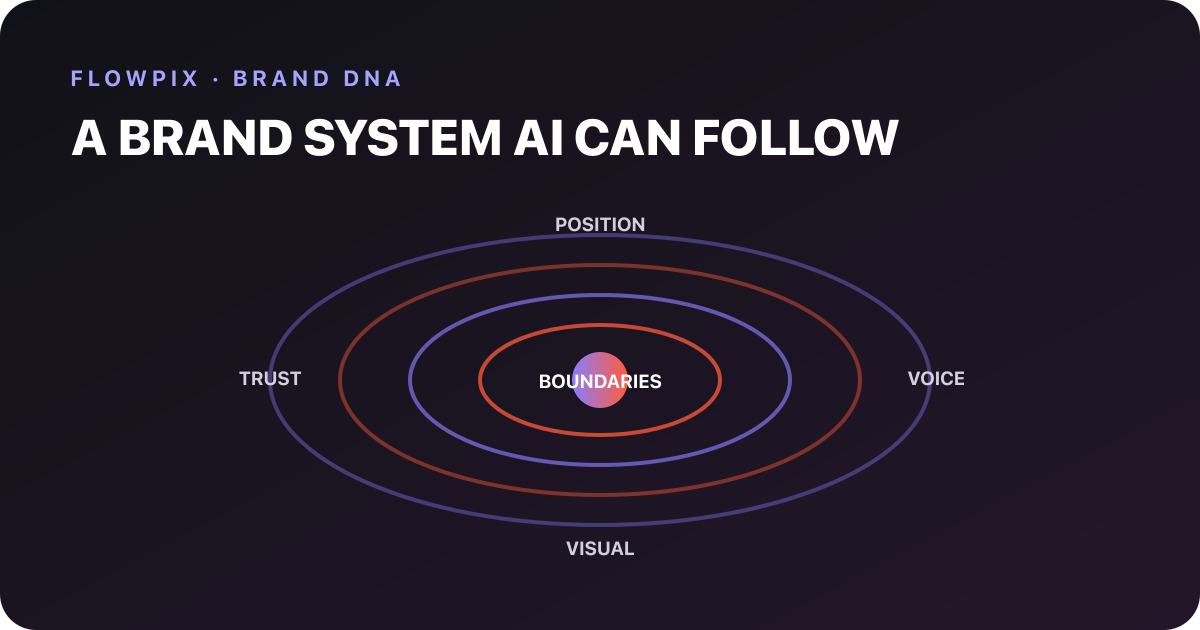
Short answer: useful Brand DNA is a compact operating specification, not a mood-board paragraph. It should define audience, promise, voice, visual system, evidence rules, exclusions, and examples so an AI system can produce options that a reviewer can judge consistently.
Key takeaways
- Write rules that can be checked, not adjectives that can mean anything.
- Separate permanent identity from campaign context.
- Include approved and rejected examples.
- Define evidence and rights requirements alongside voice.
- Version Brand DNA when the product or positioning changes.
The five-layer Brand DNA model
| Layer | Question | Useful output |
|---|---|---|
| Position | Why should this audience care? | audience, problem, promise, proof |
| Voice | How do we sound? | vocabulary, sentence rhythm, CTA style |
| Visual | How do we look? | palette, type, composition, image rules |
| Trust | What must be verified? | evidence, rights, disclosure rules |
| Boundaries | What do we refuse to create? | exclusions and escalation triggers |
1. Position: define the job of the brand
Write one primary audience and one primary promise. “For everyone who uses social media” gives AI no useful constraint. A better statement identifies the operating context:
For Instagram-first creators and teams who need visual control, we combine planning and reviewed automation so they can publish consistently without losing their brand.
Add proof that is observable—supported workflows, product behavior, documented experience—not vague superiority.
2. Voice: replace adjectives with choices
“Professional, friendly, inspiring” appears in thousands of brand briefs. Convert each adjective into a rule:
- prefer direct verbs and short openings;
- explain technical terms on first use;
- avoid hype and unsupported superlatives;
- use one clear CTA;
- state limitations without defensive language.
Then add three approved examples and three rejected examples with a reason. The reason teaches the system and reviewer what the boundary means.
3. Visual system: specify relationships
A palette alone cannot protect consistency. Define:
- dominant and accent colors;
- typography hierarchy;
- preferred crop and subject scale;
- text density;
- recurring shapes or motifs;
- rules for logos, screenshots, people, products, and generated imagery;
- how adjacent posts should vary in the profile grid.
Use the visual grid planner to test the system across several posts, not only one attractive asset.
4. Trust: attach evidence to creation
For every factual brief, record the source before drafting the caption. Mark claims that require product, legal, or domain review. For media, record ownership or license and whether synthetic content needs disclosure.
The human-review framework provides a risk-based gate. C2PA’s specification describes a technical approach to content provenance; it can support trust signals, but it does not replace editorial verification.
5. Boundaries: make “never” operational
Examples:
- never invent customer results;
- never imply a platform partnership without evidence;
- never use a person’s likeness without permission;
- never publish crisis or regulated content automatically;
- never copy a competitor’s distinctive creative;
- escalate uncertain rights or claims to a named owner.
Boundaries should say what happens next: reject, replace, request evidence, or send to a reviewer.
Permanent DNA versus campaign context
Keep two inputs separate.
Brand DNA changes rarely: audience, promise, voice, visual grammar, trust rules.
Campaign context changes often: launch, offer, dates, product focus, required asset, temporary CTA.
Mixing them creates drift. A short promotion should not silently rewrite the brand’s permanent voice.
A usable Brand DNA template
- Audience and situation
- Problem and promise
- Three proof points
- Voice rules and prohibited language
- Visual rules and accessibility requirements
- Evidence, rights, and disclosure rules
- Topics and formats to avoid
- Approved examples
- Rejected examples with reasons
- Owner, version, and review date
Use this template before building the weekly loop in the AI Instagram content planning guide.
How FlowPix uses Brand DNA
FlowPix brand tools keep brand context close to weekly planning, generation, review, and visual scheduling. FlowPix can help apply the rules consistently; it cannot verify a legal claim or create rights you do not have.
Brand DNA is available as part of the planning foundation, while generation and Autopilot capabilities depend on the current plan. Check pricing for the latest product boundaries.
Sources
- NIST, AI Risk Management Framework — governance and accountability principles.
- C2PA, Technical specification — content provenance concepts.
- Google Search Central, Creating helpful, reliable, people-first content — clear authorship, sourcing, and trust.
Sources reviewed: 2026-07-26.