AI Instagram Content Planning in 2026: From Brand DNA to Publishing
A practical, human-reviewed AI Instagram workflow for turning brand rules into a weekly plan, approved creative, and scheduled posts.
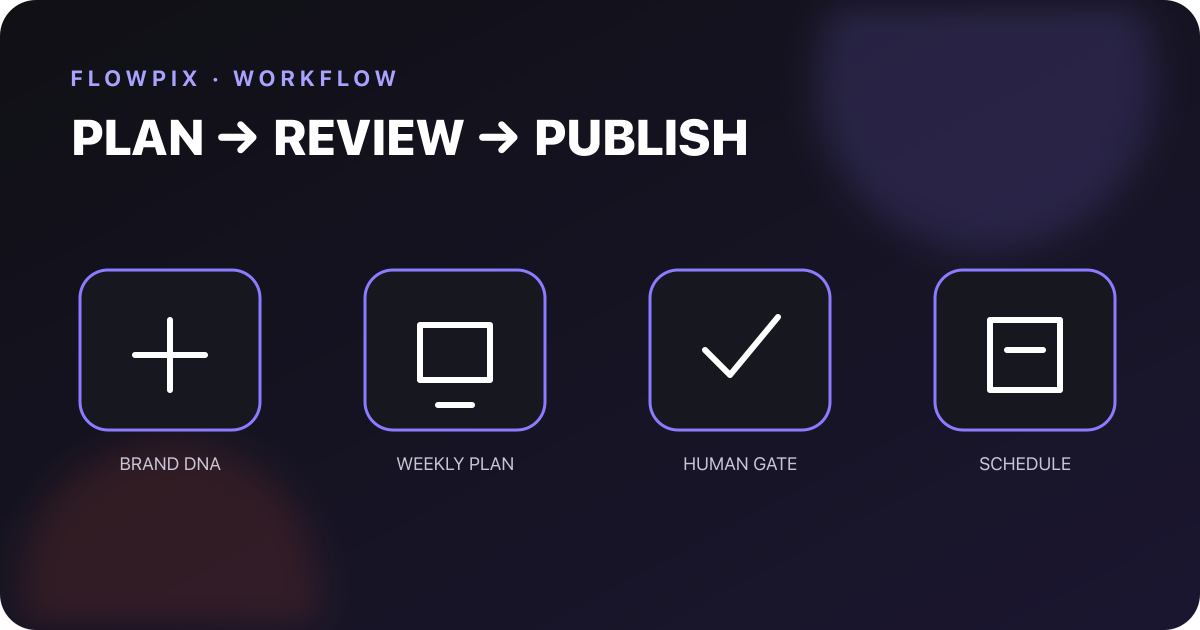
Short answer: an effective AI Instagram content planner should not jump from one prompt to automatic publishing. The reliable workflow is Brand DNA → goals → weekly slots → draft generation → visual and factual review → grid preview → scheduling → learning. AI accelerates preparation; a person remains accountable for what goes live.
Key takeaways
- Give AI stable brand context before asking for ideas.
- Plan a week as a portfolio of jobs, not seven unrelated prompts.
- Separate generation from approval and publishing.
- Review the feed as a visual system, not only individual assets.
- Record why a draft was accepted, edited, or rejected so the next plan improves.
The eight-stage planning loop
| Stage | Input | Human decision | Output |
|---|---|---|---|
| 1. Brand DNA | voice, audience, visual rules, exclusions | Are the rules specific and current? | reusable brand context |
| 2. Objective | campaign, product, education, community | What business outcome matters this week? | one measurable priority |
| 3. Content mix | formats and content pillars | Is the mix useful rather than repetitive? | weekly slot map |
| 4. Briefs | topic, hook, proof, CTA | Is each brief worth publishing? | approved creative briefs |
| 5. Generation | briefs plus brand context | Which drafts deserve refinement? | captions and visual options |
| 6. Review | copy, image, video, links | Is it accurate, safe, and on-brand? | approved assets |
| 7. Visual planning | approved feed posts | Does the profile tell a coherent story? | final order and dates |
| 8. Publishing and learning | schedule and results | What should change next week? | documented feedback |
This loop is deliberately reversible until the publish step. That matters because platform publishing APIs have format and account requirements; automation should not treat every draft as publishable. Meta documents those constraints in its Instagram content publishing guide.
Step 1: turn brand identity into usable constraints
“Sound friendly” is not enough. Useful Brand DNA answers operational questions:
- Which audience are we addressing?
- Which claims require evidence or approval?
- What tone, vocabulary, colors, typography, and composition recur?
- What must never appear?
- Which call to action fits each funnel stage?
Store examples of both approved and rejected work. Negative examples help distinguish a genuine boundary from a vague preference. Start with the free Brand DNA Builder, then keep the approved context beside the workflow in FlowPix brand tools.
Step 2: plan jobs before posts
A weekly plan should assign a job to each slot. A balanced example might include:
- a discovery post that explains a problem;
- a proof post that demonstrates experience or results;
- a product post that shows the workflow;
- a community post that invites a response;
- Stories that support, rather than duplicate, the feed.
This prevents the common failure mode where AI produces several polished posts that all say the same thing. The plan becomes a portfolio: each slot has an audience, purpose, format, evidence requirement, and next action.
Step 3: generate options, not final answers
Ask for two or three directions per approved brief. Variants should differ in angle, structure, or visual concept—not just swap adjectives. A useful draft package contains:
- the proposed hook;
- the key claim and its source;
- caption;
- visual brief;
- format and dimensions;
- CTA;
- known uncertainty.
Google’s guidance for AI-assisted web content is a useful general principle here: automation is not the problem by itself; publishing material that adds no value or exists mainly to manipulate discovery is. See Google’s guidance on generative AI content.
Step 4: run a human review gate
Use four passes:
- Truth: claims, names, dates, links, product availability.
- Brand: voice, vocabulary, visual rules, audience fit.
- Platform: dimensions, format, rights, disclosure, publishing compatibility.
- Purpose: does the post still achieve the slot’s job?
The reviewer must be able to reject, request changes, or approve. Silence is not approval. See the companion guide to human review in social media Autopilot.
Step 5: review the grid and schedule
An individually strong image can still create a weak profile. Preview approved feed posts together and check repetition, color rhythm, text density, campaign sequence, and pinned content. Stories and carousels should be planned alongside the feed even when they require a different publishing path.
FlowPix’s visual grid planner is designed for this checkpoint. FlowPix can schedule supported single-image and video posts after review. In FlowPix 2.0, Stories and carousels remain planning drafts rather than automatic publications; the current scope is documented in the FAQ.
What FlowPix does—and does not do
FlowPix combines Brand DNA, weekly AI plans, image and video generation, review, grid preview, collaboration, and scheduling in a native iOS and Android workflow. Premium and Pro differ by planning horizon, generation allowances, platforms, and multi-brand capability; use the current pricing page rather than copying quotas into a long-lived workflow.
FlowPix is not a replacement for strategy, legal review, or performance analysis. It does not guarantee reach, and it should not publish an unreviewed claim merely because the asset looks finished.
A practical definition
AI Instagram content planning is a controlled system that turns stable brand context and weekly objectives into reviewed, visually coherent, publishable content—while keeping a human accountable for the final decision.
That definition is more useful than “generate 30 posts in one click” because it describes the operating system, not only the output.
Sources
- Meta, Instagram Platform: Content Publishing — publishing requirements and constraints.
- Google Search Central, Guidance on generative AI content — value and quality principles for AI-assisted publishing.
- Google Search Central, Creating helpful, reliable, people-first content — authorship, sourcing, and usefulness.
Sources reviewed: 2026-07-26.